'We Two Are Old'
Qian Zhongshu and Yang Jiang's story, told through my translations

1.
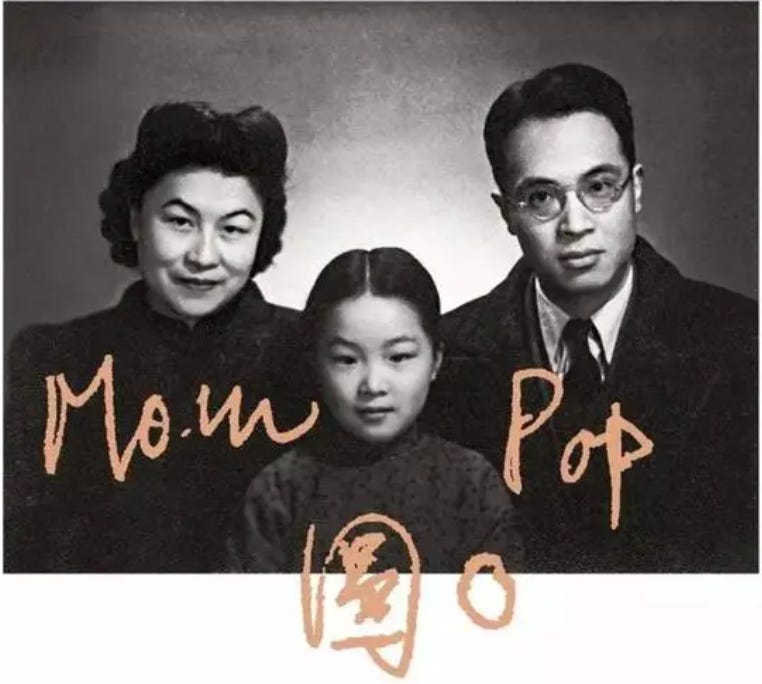
This is the story of a Chinese intellectual ‘power couple’, Qian Zhongshu (1910-1998) and his wife Yang Jiang (1911-2016).
2.
Qian Zhongshu is rightly called ‘the most learned author of twentieth-century China’. Fluent in English and French, he also read widely in German, Italian, and Latin — all of which languages appear, alongside modern and classical Chinese, throughout his writings. Here is Yang Jiang’s recollection of her husband’s language proficiency:
The year we were in Paris, Zhongshu threw himself wholeheartedly into reading. In French, he began with the fifteenth-century poet Villon, and worked his way one by one through to the great authors of the eighteenth and nineteenth centuries. In German he did the same. He read in Chinese and English every day, in French and German every other day, and later squeezed Italian into the roster.
This was a year of joy for Zhongshu, who fiercely loved reading. When we first arrived in France, we read Gustave Flaubert’s Madame Bovary together, and many more of the words were new to him than to me. But by the end of the year, his French was miles ahead of my own.
Qian’s most famous work, 《围城》(Fortress Besieged), is a satirical novel set in wartime China. Fortress Besieged bears strong imprints of the French existentialist, Sartre. The novel’s protagonist, Fang Hongjian, enters into a contentious marriage with Sun Roujia. Though both are well-meaning and good-intentioned, the couple spends much of the novel ribbing each other intentionally, insulting each other unintentionally, and eventually growing physically violent towards one another. The novel ends with Fang Hongjian realising that he is trapped in an unhappy spiral of inescapable conflict.
Reflecting on his failing marriage, Fang Hongjian thinks,
By nature, man was meant to be alone […] When we all get close together, it’s either I offend you or you insult me. People are after all like so many hedgehogs. We’ve got to keep a safe distance away from each other — that’s all there is to it. If we all clump up, I’m sure to prick your flesh, and you’re sure to tear my skin.
Knowing next to nothing about Sartre, I hand over commentary to the Chinese critics Gao Xudong and Dai Bo in this brief translation from their essay on the novel:
The existence of others is a constant threat to one’s subjectivity – I can transform others into the objects of my subjectivity, but they are capable of doing the same to me. Thus, “Hell is other people”, and marriage becomes a pitched battle in which each party involved seeks to dominate the other’s subjectivity – an inescapable fortress besieged.
And indeed, the title of Qian Zhongshu’s novel, Fortress Besieged, comes from a French proverb: ‘Marriage is like a fortress besieged; those outside want to get in, and those inside want to get out’.
3.
From this gloomy view of interpersonal interaction and marriage, one would never guess that Qian Zhongshu himself was happily married. While he was studying at Tsinghua University, he met his life partner Yang Jiang, and they wed in 1935. The couple studied abroad in Oxford and Paris together, and per Yang’s recollection:
Zhongshu and I fought once, on the ship out from China. We had a spat over the pronunciation of the French word bon. I accused him of speaking it with an imperfect accent. He disagreed, and said some really cutting things in reply. I also tried my best to hurt him.
Later I brought the matter to a French woman on the ship who spoke English. She said I was right, and Zhongshu wrong. I had won, but I felt no satisfaction; and of course Zhongshu felt none either, for he had lost.
There is a proverb that goes: “When newlyweds fight on the bow of a ship, they make up on the stern.” We soon grew bored of being on bad terms, and agreed to disagree.
But in the years following this, we never had another fight. Whenever anything important came up, it never took more than a few moments to agree on a course of action. If our opinions differed, we’d compromise — neither of us could be said to have the upper hand.
Yang Jiang and Qian Zhongshu’s marriage, as you see, could not have been further from Fang Hongjian and Sun Roujia’s in Fortress Besieged. I have been speaking of Yang Jiang as ‘Qian Zhongshu’s wife’, but she was a formidable intellectual in her own right. Already confident in French, English, and German, she taught herself Spanish so that she could translate Don Quixote into Chinese, and her Chinese translation is still considered the definitive one. And the couple’s daughter, Qian Yuan, born in 1937, became a professor of English literature at Beijing Normal University.
I am studying Qian Zhongshu’s Fortress Besieged for my thesis, and recently, I have been needing some light reading that is still (nominally) related to my research. So I picked up Yang Jiang’s autobiographical essay collection, 《我们仨》(We Three).
I thought We Three would be happy recollections of a family who not only loved and respected one another, but shared intellectual common ground. What I did not know, and what I very quickly learnt within the first few pages of We Three, was that both Qian Yuan and Qian Zhongshu died within months of each other in 1997 and 1998 respectively, the daughter of spinal cancer and the father of old age. Left behind was the mother, Yang Jiang, who wrote this memoir of family life from the perspective of her new solitude.
I can’t even imagine what those last years of Qian Zhongshu and Qian Yuan’s lives must have been like for Yang Jiang — running back and forth from hospital to hospital, carrying news of an ailing father to a dying daughter, first by letter and then by word of mouth as both father and daughter grew too weak to write.
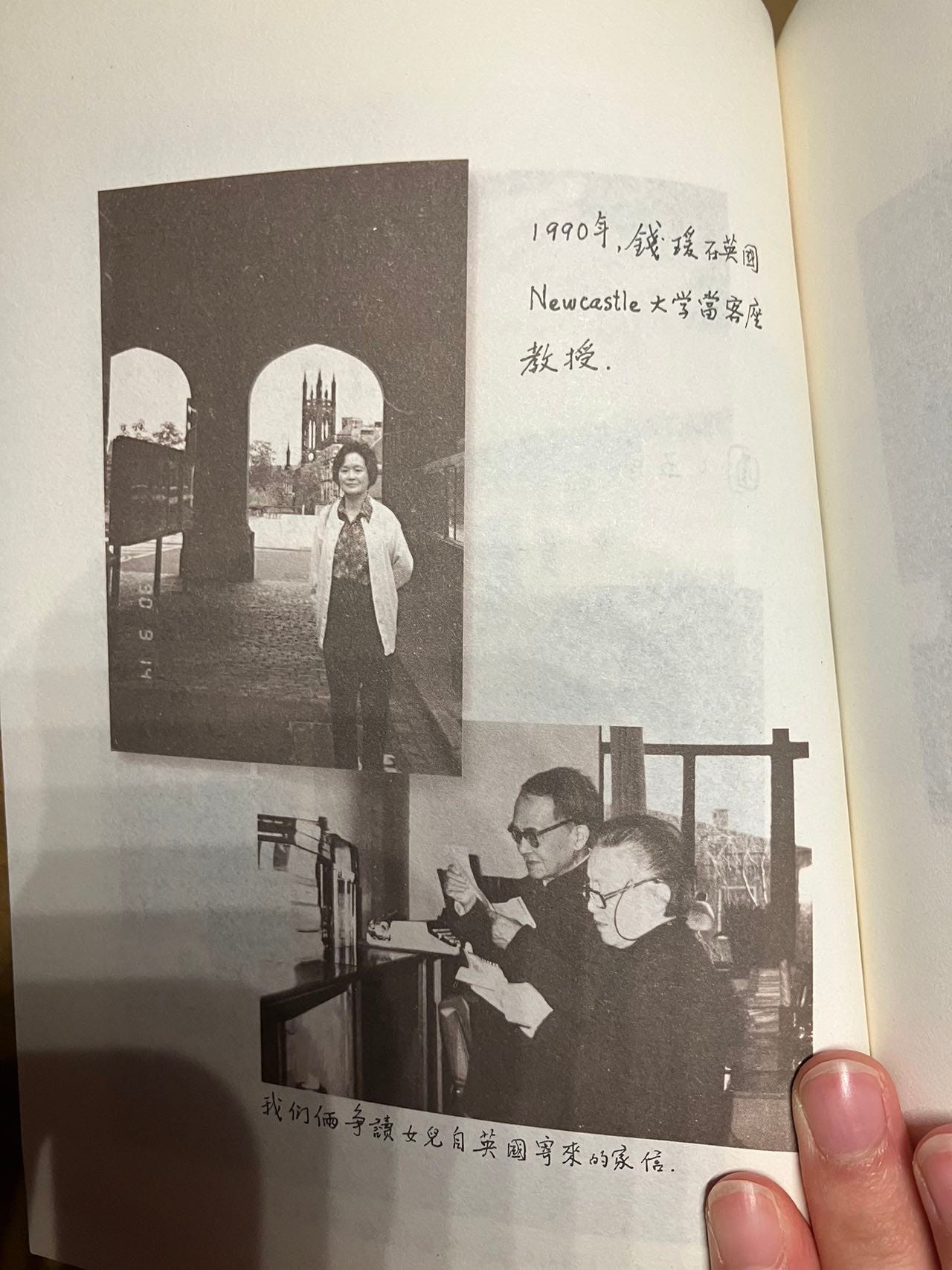
We Three contains family photos and documents with handwritten notes by Yang Jiang. This is one of my favourite pages from the book.
The top photo is of Yang Jiang and Qian Zhongshu’s daughter, Qian Yuan, at Newcastle University on a guest professorship in 1990.
The bottom photo is one of the couple at the post office in China, tearing open their daughter’s mail from England.
Perhaps Yang Jiang would agree with her husband, Qian Zhongshu, that ‘Hell is other people’ — but in the sense that to grow close to others leads to love, and to love leads to grief. The pages of We Three are so filled with pain that I could only take them in short doses.
But what is so poignant to me is that, despite this, We Three evinces an exactly opposite view on subjectivity as Fang Hongjian does in Qian Zhongshu’s Fortress Besieged. Yang Jiang construes herself in relation to her husband and daughter. Unlike the protagonists of Fortress Besieged, her relationship with her family does not erode her subjectivity. She exists because she is part of ‘we three’, as does the rest of her family. Her subjectivity is constructed in terms of ‘we’, not ‘I’.
Yang Jiang’s book is structured thus.
Section One: We Two Are Old.
Section Two: We Three Are Parted.
Section Three: We Three, Remembered Alone.
Section Two, ‘We Three Are Parted’, is the best of the book — a long, surrealist chapter in which Yang Jiang describes the years of her daughter’s and husband’s deaths, 1997 and 1998, as a dream sequence in which she cannot tell the truth from her nightmares, and from which she cannot wake. This sequence was agonising to read and impossible even to attempt to translate. I can only hope that someday I will have the courage, empathy, and strength to do it justice.
So I have only translated the book’s opening essay, ‘We Two Are Old’, which introduces the dream sequence in the second chapter. I have also translated the opening of Section Three: ‘We Three, Remembered Alone’.
4.
Section One - ‘We Two Are Old’
One night I had a dream. Zhongshu and I were walking together, talking and laughing, forgetful of time and distance. The sun had set and in the opaque twilight, I turned and Zhongshu was gone.
I searched high and low, but there was no trace of him. I called him, and there was no answer. I, alone, standing in the midst of the deserted fields, not knowing where he had gone. I shouted at the top of my voice: his name, his full name — and my cries fell and were swallowed by the emptiness, which returned not even an echo.
The night grew thick; the utter silence deepened my loneliness. I strained my eyes through the layers upon layers of darkness. Beneath my feet was a dirt path; beside me there was a wood and running water, but I could not see how wide the stream was, nor a way across it. I turned and through the darkness saw a village, houses and barns, as if there had once been people living there, but very long ago, for there was no sign of light or life.
Had Zhongshu gone on home before me? Well, it followed then that I had to go home to find him. As I was pondering how best to return, an old man pulling a rickshaw appeared — and I managed to hail him. But when I opened my mouth to tell him to take me home, no sound would come.
And then my fear woke me, and Zhongshu was by my side, sleeping soundly.
I tossed and turned half the night till Zhongshu woke and asked me what the matter was. I told him I had had a dream — and I told him what had happened in the dream. I accused him of leaving me, of going off on his own without a word or sound. And, thus awoken, he made no excuses for himself. He said, comfortingly, that it was a dream old people often had. He had had it himself, many times.
That is true, for I have had the same dream since, many times. The same dream — though it happens in different places. We two, walking together, till Zhongshu vanishes in the blink of an eye. I ask everyone I can find — ‘Have you seen my husband?’ — and no one replies. Or I search for him, high and low, and every path I find leads nowhere; or I am waiting at the bus stop for a late bus home that never comes. In these dreams, through my fear, I have one blurred impression: If I can just find Zhongshu, we can go home.
Perhaps Zhongshu still remembers how I woke him that first night with my complaints. For he has left me to dream this dream unendingly.
5.
In the following translation from the final section of We Three, ‘We Three, Remembered Alone’, I have paid special attention to Yang Jiang’s use of pronouns. I have made a special distinction between her use of ‘我们仨’ (which I have translated as ‘we three’) and her use of ‘我们三个’ (which I have translated as ‘the three of us’). I believe there is a crucial difference between the two that I have tried my best to preserve in translation.
Section Three - ‘We Three, Remembered Alone’
The apartment at Sanlihe was once my home, because we three lived there. We three are parted, and it is home no more. I am the only one left, and I am old; I am a weary traveller at sunset, with nowhere to go. Meandering at the end of time, what can I do but exclaim: “Life is like a dream”?
And yet though I speak so now, I do not say that my life has been an empty one. I have lived a full life, a life of meaning, because we three lived life together. Or to put it another way, because we three were we three, not one of us lived in vain.
‘We three’ — how ordinary a phrase. Which family has not a husband, a wife, and children? A husband and wife, and children — that makes ‘the three of us’, or ‘the four of us’, or even ‘the five of us’, depending on the family.
This particular ‘three of us’, our particular family, was the simplest of all. We asked nothing of the world and had no quarrel with anyone. All we wanted was to be together and to stay together, each doing what they could to the best of their ability. Zhongshu and I faced all our troubles together and so every burden was lightened. And with our helpmate and companion, Ah Yuan, each sorrow was transformed into a joy, and the smallest of happinesses grew exquisite.
So we were no ordinary ‘we three’.
Now the three of us are parted. The past is past and the dead are gone. What is left — that is, I — can never find them again. All I can do is to revisit the years we spent together — and seek, in this way, a kind of reunion.